Supported By


Department of Consumer Affairs
Government of India

What's New

Advocacy Document


Event


Public Event to observe World Consumer Rights Day (WCRD) 2012
March 16, 2012, Jaipur

---------------

District Partner's Orientation Workshop
March 15, 2012, Jaipur


Publications


Status of Consumers in Rajasthan 2011


In Media


Unaware About Rights Even After 25 Years
Rajasthan Patrika, Jaipur,
November 08, 2011


L
ack of consumers' access to adequate information, improper understandings of the redressal mechanism/procedure as well as other socio-economic vulnerabilities of individuals and households are the reasons that the under-privileged classes are not getting justice.

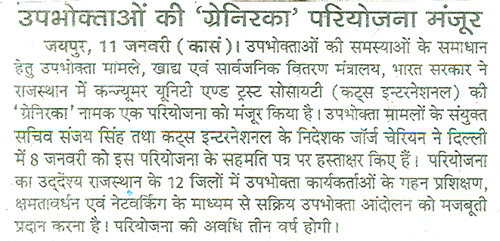
To address the problem, CUTS is partnering with the Department of Consumer Affairs, Ministry of Consumer Affairs, Food and Public Distribution, Government of India, under the Consumer Welfare Fund (CWF), to implement the project entitled ‘Grassroots Reachout and Networking in Rajasthan through Consumer Action’ (GRANIRCA) in 12 districts of Rajasthan. The purpose of this project is to enhance strong consumer movement at the grass roots in seven divisions of the State by ensuring an enabling environment for protecting consumer’s interests, which will, in turn, contribute towards national interest.

Specific Objective

The objective of the project is to build a strong consumer movement at the grassroots by equipping consumer activists with skills and creating a network of zealous grassroots activists through intensive training, capacity building and orientation programmes on relevant consumer protection issues.

Supported and Implemented by

The project is being implemented by CUTS Centre for Consumer Action, Research & Training (CUTS CART), with financial assistance under the Consumer Welfare Fund (CWF) by the Ministry of Food and Consumer Affairs, Government of India.

Project Duration and Coverage

The duration of the project is of three years, i.e., January 2010 to December 2012, covering all seven divisions of Rajasthan.

Expected Outcomes

  • Empowerment: People in 12 districts will be assertive consumers to uphold their rights and fight for justice.

  • Questioning Society: 12 civil society organisations (CSOs) will act as “watchdogs”.

  • Enforcement: Better service delivery and efficient redressal mechanism in place.

  • Enabling Environment: Protecting consumer’s interests, which will ultimately create an enabling environment towards protecting the state interest.

  • Good Governance: Contribute towards achieving the Millennium Development Goals (MDGs).

  • Replicable Model: Result in a model of empowering consumers through networking, and thus offer a model for further expansion in the identified district and elsewhere.

Copyright © 2010 CUTS International. All rights reserved.